Monday, June 16, 2014

Treasure Galleon!

What words call up a more vivid picture of treasure and adventure? The giant ship, laden with gold, just waiting for pirates capture her and make their fortune. But what is a galleon, anyway?

Very simply, it was a type of ship. In the modern world, we don’t see much difference between different types of ship, But the galleon is easy to identify.


Sailing ships have changed over the years, in much the same way as cars develop, and for very similar reasons. Money drives a need for better technology.

The famous galleon developed from the carrack. This was a very primitive type of ship, based on the idea that a sailing vessel should be shaped like a half-moon. The bottom was rounded, the sides bowed out, and the front and back of the ship were sharply raised. By putting all the weight in the center of the ship, and raising the bow and stern, builders created a vessel that was very hard to sink. It was also hard to steer, and did not move very fast.


Columbus’s Santa Maria was a carrack. It took her 10 weeks to cross the Atlantic.

The galleon was an early effort at scientific ship-building. It was not a ship based on theory, but on practical application. Pedro Menéndez de Avilés and Álvaro de Bazán, captains in the Spanish Navy, were credited with the actual invention of the galleon at about 1550. They wanted a ship that worked for long sea voyages.

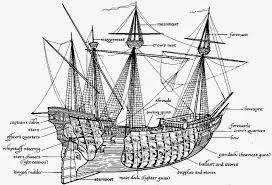
Like the carrack, the galleon had a very raised stern, sometimes four or five stories above sea level. This gave a raised platform for the officers to oversee the work of the ship, and provided comfortable living quarters for the gentlemen. Often the stern of the ship was richly decorated. Galleons were often named after saints, and the image of the saint was painted across the massive stern of the ship. The vessels were brightly colored, and detailed in real gold leaf. Sometimes even the sails were painted, two favorite themes being a large red cross, or Spain’s coat-of-arms.


The front of the ship was much less raised, the sides were nearly straight and much more streamlined. It was a ship made to sail long distances. Magellan used it on his voyage around the world, and Francis Drake used another - The Golden Hind - on his voyage. Drake took some time out on his trip to stop by a Spanish settlement, where he used the firepower of his galleon to seize a smaller Spanish ship, capturing so much gold that he needed 6 days to move the treasure onto his ship.


When he made it back to England in 1580, he paid back his investors at a rate of 4,700%, giving Queen Elizabeth I so much money that she was able to pay off the national debt with it. She knighted him, which proves that piracy does pay.

Galleons quickly superseded the carrack as warships (One Portuguese galleon was said to carry 360 cannons.) but they were also large enough to act as transports, and some were refitted several times as they alternated between the two tasks.


The galleon became the prototype of the “fully rigged ship.” It usually had three masts. The front two masts had two square sails each, one above the other. The last mast had a triangular sail hung from a slanted crosstree, a rig which is called a “lanteen rig.” In addition, the front of the ship had a prominent “nose,” called a bowsprit, where another square sail was hung.

The rigging, or rope-work, on the ships was becoming more complex as well. During the long sea voyages, it was not uncommon for most of the crew to die, either from malnutrition, thirst, or from exotic diseases. Left with a crew too small to work the ship as it was designed, the sailors were forced to invent new ways to move and secure the sails. Once invented, these methods spread to other ships.

The English modified the ship’s design for their own uses. John Hawkins, an English captain, developed a longer, lower “race built” galleon that was faster and more maneuverable. When the Spanish Armada attacked England in 1588, both sides were sailing galleons. In that confrontation, the English forces used fire-ships to scatter the armada (which is the Spanish word for ‘fleet’), which then met with severe storms that scattered it farther and drove many ships aground.


The loss of their armada was devastating to Spain. Each of their 130 ships had required months of work by hundreds of highly specialized craftsmen, and many specialized materials. The keel was made of oak, the masts from pine, the decks and fittings of other hardwoods. Building the Armada destroyed the forests of Spain, which have never recovered.

But Spain still had the gold and silver from its New World colonies, and galleons – large and heavily armed – continued in use. Carracks had long sense been consigned to use as cargo ships, but heavily armed galleons could haul cargoes of gold. Ship technology continued to march forward. New ships were being invented all the time. Schooners, barques, barquentines, fluyts, were faster and more maneuverable.  The Spanish, however, were not stupid. Their treasure ships traveled in fleets.


After the age of the buccaneers, when men like Drake used government money to obtain galleons of their own, which they used for piracy (based on the concept that if you were on the other side of the world and no one could catch you, anything was okay.) no pirate every robbed a galleon.

If you want to see a galleon, you need look no farther than Roman Polanski’s 1986 movie, Pirates! Though the movie only earned a 25% rating on Rotten Tomatoes, it has been praised for its acting. A full-scale galleon was built for the movie, a replica of the 17th century Spanish Galleon Neptune. Above the waterline, the boat is nearly perfect, but below the waterline it had a steel superstructute and a 400 horsepower engine. The ship played the part Captain Hook’s Jolly Roger in a made-for-TV series, Neverland. You can see the ship today, if you go to Genoa Italy, where it is on display for a 5 Euro fee.


Monday, June 9, 2014

Dastardly Merchant Captains

In the year 1707, in a court of law, James Conroy testified that Captain Wherry, “catched him fast by the Nose with his left hand & thrust his thumb into his left Eye & with his right hand struck three Blows on his said Thumb & in that manner willfully, designedly & maliciously maimed and put out his eye.”


A vicious attack by a pirate captain on one of his helpless victims? Not quite. This is the record of a merchant captain disciplining a member of his crew.

In the early 18th century, ship captains were virtually all-powerful aboard their ships. The law said that they could physically discipline their crews using “moderate punishment’ but there was no governing body to monitor this. Alone at sea, merchant captains did whatever they wanted.

When one sailor, Richard Baker of the Europa, became sick from the bad food, he was still ordered to his regular duties. Too ill to comply, he was ordered to take the helm for four hours “Which is two men’s turns.” His commander, James Blyth, then whipped him with a knotted rope, and when that did not make him stronger, he was tied dangling from the mizzen mast for an hour and a half. Cut down at last, he died four days later.


Was it murder? A modern mind says yes. But it wasn’t nearly so obvious in the 18th century.
The records we have of these crimes comes primarily from court cases, but the court system worked very differently 300 years ago. In order to bring a case, the accusing party had to first pay all the court costs up front. Attorneys had to be hired, and in the British legal system a lawyer needed to be hired as well.

Sailors, who were working men, rootless, homeless, poorly paid, often illiterate, were seen as little more than animals. Merchant captains were most often from middle-class families. They needed to be educated in order to carry on the business of the ship, buying and selling cargo, trading in different currencies.

The most common case brought against merchant captains by their crews was a complaint of bad food. Captains were usually paid a share of the profits of a voyage, and it was in their best interest to keep expenses as low as possible. One way to do this was to buy the cheapest food possible for the crew. Often this meant meat that was improperly cured, which rotted during the voyage. Sailors expected to eat bread infested with weevils, salted meat that might be raw, and a steady diet of boiled, dried peas. But often the food was bad enough that, once in port, they clubbed together their meager pay and took the captain to court.


The problem was that the captain was a gentleman, and the judge was a gentleman too. There would be no evidence to bring… It had all been eaten. It was the testimony of the men against the testimony of the captain. The men would swear the food was bad. The captain would say that it looked okay to him. (He certainly hadn’t eaten any of it. Captains kept a separate larder for themselves.)

Faced with this testimony, it was more than likely that the judge would see things the captain’s way.
But crews still brought complaints. Sometimes they even won.


Even if they didn’t, the sailors carried the tales with them. By 1715, a new spirit was beginning to grow among merchant sailors. They felt a sense of kinship that transcended national, language or even racial differences. Sometimes crews staged work stoppages. Sometimes they mutinied. Sometimes the line between the two was very thin. One crew succeeded in bringing a ship they had signed onto right back to port because it was leaking so badly. They might have been thrown in jail for this, had not the next crew signed onto the boat done exactly the same thing.

Often underpaid, sailors began refusing to work while their ship was in port (merchant captains wanted them to unload the ship.) And when a captain tried to head out to sea with a crew too small to properly handle the ship (another method to save money and increase profits) they sometimes refused to work the sails. And when the ship was attacked by pirates, they often joined the pirate crew.

This was the way that pirates recruited. They simply asked the crews of the ships they captured if anyone wanted to join up. Sometimes every man on board signed on. Then the officers of the captured ship were put off in a rowboat, and the merchant vessel became a pirate ship. The pirates provided navigational help, and the newly fledged pirate ship usually followed the “parent vessel” for a while. A change of name was also in order.

And the most common name chosen for a pirate ship?

Revenge.


Monday, June 2, 2014

Ponce de Leon and The Fountain of Youth

One of the most persistent legends of Florida, the story of the Fountain of Youth tells how Ponce de Leon came to the tropical peninsula searching for a magical fountain that would restore health, remove years, and even bring the dead back to life. As a child growing up in Florida, it was the earliest history I learned. I always felt a great deal of sympathy for the Conquistador, wandering through the swamps and palmetto thickets of early Florida, looking for something that wasn’t there. But that was his legacy, the thing that he was known for. His quest for the mythical fountain defined him because he spent his life and career looking for it.


Except that he didn’t

The legend of a magical fountain goes back at least as far as the ancient Greeks. Herodotus (who also wrote stories about a Persian army so large it drank the entire Mediterranean Sea dry) told of a mystical fountain, whose waters gave an entire race of humans unnaturally long life.

But the story may go back farther yet. Old Celtic legends say that the magical cup of Cerridwyn gave forth magical, life-giving waters. These, along with many other stories, in turn contributed to the legend of the Holy Grail.

Magic water has been an important topic for millennia.


The legend lives on in stories of places like Lourdes, a native spring in France whose waters have been said to bring healing even to the paraplegic.

Why all the stories of the magic water?

I think it helps to understand the state of public utilities in ancient times. Pretty much, there were none. People drank directly from rivers, lakes and streams. Germs lived in the water and people did nothing about them because they didn’t know such things existed. If a village was especially lucky, it had a natural spring nearby. Spring water was cleaner, being filtered by earth and sand.


Sometimes streams or rivers became poisoned. There was simply no way to know if there was a dead cow rotting upstream, or someone had dug a latrine that was poisoning the water source. Of course, when things like this happened, everyone didn’t get sick. In order to survive at all, a person living in ancient times needed an immune systems as fierce as a whole pride of lions. But some people wouldn’t be able to shrug it off, and these people got sick.

It was soon learned that a change of water helped these folks, and so certain sources, the ones that were situated in places that never got polluted, gained the reputation of possessing “healing waters.” If you came there with a sick stomach, stayed a while and drank the relatively germ-free water, you got well.
From there, it was relatively easy to imagine a “super fountain” that granted longer life.


Juan Ponce de Leon was a bastard grandchild of the king of Spain. (The suffix “de Leon” was added to the family name “Ponce” because of the royal connection.) Born in 1474, he had no real opportunity to achieve fame or fortune in his native land. So he sailed with Columbus on the second voyage of discovery. He received a land grant in the New World, married and became quite prosperous. He was also instrumental in putting down a native rebellion.

Despite political conflicts at home in Spain, Ponce de Leon was made governor of Puerto Rico. He found gold here, and established plantations, dutifully sending a cut of all profits back to the Spanish Crown.

Other Spaniards, more politically astute, were gaining properties and governorships in the Caribbean, and the grateful king was running out of lands to grant. However, rumors had surfaced of an island further north, called “Beminy.” In 1512, Ponce de Leon was granted permission (but no money) to look for this island, and to rule it, and any other islands he found on the search.


It is hard to believe how crude navigation was at the time. Heading north, the three ships in the expedition blundered into the side of Florida, which Ponce de Leon named in honor of the season of Easter, which the Spanish called Pascua Florida, the Festival of Flowers.

Exactly where he landed remains in dispute, because of the limits to calculating location. Juan Ponce de Leon may not have been the first Spaniard to find this land, but he was the first European to record the effects of the Gulf Steam… the powerful current swept one of his three ships out into the Atlantic Ocean, and it was nearly lost.

For the next 19 years, he divided his time between explorations of this new land, visits with his family in Puerto Rico, and trips to Spain. In between he fought the natives of the region. These tribes had originally been friendly to the Spanish, but after years of enslavement and religious conversion through torture, they had had enough. One by one the tribes rose against the Europeans. Ponce de Leon’s house was burned in one attack, and his family barely escaped.


He was on his third expedition to Florida when he was hit by a poisoned arrow fired by a member of the Calusa tribe. Though he lived long enough to be evacuated to Havana, he eventually died from his wound.
It was only after his death that the Fountain of Youth was attached to his name. Rumors of the Fountain had run through the region for decades. This was the origin of the “Island of Beminy.”  Natives had spoken of a tribe to the north who lived unusually long lives. Scholars currently believe they were talking about the Maya, and simply got their directions a little mixed up.

But the rumors had circulated. And Ponce de Leon had political enemies back in Spain, enemies who wanted to make a fool of him. So the rumors were twisted. Instead of exploring a region of the New World looking for slaves, gold, farmland, or other things that Spanish colonies had produced, his enemies said that he had been looking for the Fountain of Youth. It was whispered, then said, that he needed it, because he was “unable to perform as a husband.” Snickers ensued. It was a good story, and it stuck. It stuck for 500 years, and is now so engrained that it can’t be removed from Florida history, even with facts.

What price fame, Juan?


Monday, May 26, 2014

Taking Care of a Pirate Ship

We like to think of a pirate crew as being jolly fellows, out for a good time, drinking rum to excess and then sleeping it off with abandon. But the Golden Age of Piracy was an age of wooden ships, and wooden ships need taking care of, especially in a tropical climate.

If you ever read Captain Johnson’s The General History of the Robberies and Murders of the Most Notorious Pyrates (published in 1724 and still available today) you will notice that, about every six weeks to three months, the pirates “stopped to clean.”

So what, exactly, were they cleaning?


It was the bottom of the ship, the proper name for the task was “careening,” and doing so took quite a lot of work. First, a safe harbor had to be found, far from the prying eyes of the authorities, because the pirates would be effectively helpless for the duration. Fortunately the Caribbean offers many uninhabited islands, and anyplace off the regular ship lanes would do. A spot with fresh water, fruit trees, and wild game was ideal.

Next the vessel had to be lightened. This was done by putting everything in it, piece by piece, into the longboat, and rowing it to shore. There it was unloaded, so the boat could go back for more. Soon the island’s shore would be stacked with crates and barrels. This was where it was handy to have water nearby, because the pirate ship’s water supply, usually several tons in weight, could simply be emptied into the ocean.


Then long, heavy ropes were run from the ship to the land, and the pirates went to work. Using nothing more than the strength of human bodies, they dragged their entire ship onto dry land.

Of course, this was very difficult, but they had a few tricks to aid them. For one thing, a beach with a long, gentle slope would have been selected. For another, the work would be done at high tide, with the ocean helping. Then, as the water retreated at low tide, more of the boat would be out of the water.

Why go to all this effort to clean the bottom of a ship, where no one would ever see? They weren’t just cleaning off dirt. The pirates were removing barnacles, seaweed and other marine growths. It was very important to keep the bottom of the boat as smooth as possible. An uncleaned hull could be dragging tons of shells, and hundreds of yards of trailing weed. Such things could cut a ship’s speed in half. Pirates depended on speed, both to catch their prey and to escape from Navy ships.


Merchants knew this too. But for them, taking the time to clean a ship meant time taken from running cargo. It cut into profits. Furthermore, merchant sailors counted on having time off when the ship was docked. Cleaning the bottom of a ship was hard, dirty, work, and they wanted extra pay for doing it. Pirates were cleaning for their own lives, and didn’t mind nearly so much.


Another thing that drove the pirates to clean so carefully was a creature called teredo navalis, or the common shipworm. It was not actually a worm at all, but a saltwater clam. But its home was on floating wood, and in the age of wooden ships it was a plague like no other.

Shipworms dug into the hulls of ships and turned them into honeycombs, so riddled with holes that they could be torn apart by a man’s hands. A ship riddled with these creatures was a floating coffin, constantly leaking, delicate enough to break apart at the slightest stress from wind or water.


Merchant sailors, and the navy, tried everything to keep shipworm at bay. In 1710, the best they could come up with was a coat of white lead paint next to the wood, and a coat of tar over the white paint. Pirates often couldn’t get these things, so they careened regularly.

Of course, being pirates, they did their best to keep the work as easy as possible. On at least one occasion, pirate captain Sam Bellamy took advantage of the crew of a merchant ship he had captured by forcing them to clean his pirate ship. The merchant sailors took two weeks to finish the job, which is probably why the practice didn’t spread.


But on many occasions, the pirates turned this chore into an excuse to party. The incentive to get the ship back in the water was high. But some crews made themselves feel more secure by building an on-shore barricade from sand or barrels, and arming it with the ship’s cannons (which, being heavy, had to come on shore anyway.) Some descriptions of this make it sound like boys building a fort, with much more elaborate fortifications than were actually called for. Given the cooperative nature of pirates, I can easily imagine some competition between groups to see who could make the coolest wall.


But a more universal practice was the after-careening party. With the ship back in the water, work turned to gathering fresh provisions… shooting birds, hunting for wild pigs or goats, picking fruit and peppers. In the meantime, the ship’s cook would be setting up for roasting, stewing, pickling, frying and baking. The liquor was already on shore. Sometimes the party lasted for days.

In fact, one pirate party, along a particularly popular stretch of beach in the Carolinas, is said to have gone on for months. As one pirate crew ran out of booze, or stamina, the next crew would show up, with barrels full. At some point, prostitutes began to arrive. It became the longest running celebration in history.


Except that, afterwards, the ships probably needed to be cleaned again.


Monday, May 19, 2014

A Pirate's Favorite Songs

What music did pirates listen to?

Many people have written about sea shanties, and songs such as “What do You do With a Drunken Sailor?” are deeply embedded in our concept of all things having to do with ships and the sea.


What shall we do with a drunken sailor?

Shanties were work songs, and their length and structure was adapted to specific types of work. Capstan shanties had a rhythm useful for keeping men in step as they turned the capstan. “Long haul shanties” had long lines and many verses, to keep the sailors in rhythm while they raised sails or pulled the ship in to shore, while “short haul” shanties were briefer, so the men working on a shorter task would not run out of work before the song was over.

Come all ye young fellows that follows the sea
To me, way hey, blow the man down
Now please pay attention and listen to me


But, one and all, shanties were work songs. And while they were enjoyable to listen to or to sing, once work was done, sailors wanted to listen to something different.

Much classical music comes down to us from this period, but working class people were not likely to have opportunity to hear much of it.  It required technical skill and a high-quality instrument – often an orchestra of them – to perform. In the days long before music was recorded, this kind of live performance was a luxury of the rich.


Instead, travelers such as sailors and pirates crowded into alehouses to drink and sing. Popular music of the time was not something you listened to. It was something you made yourself.

Alehouses hired fiddlers when they were able, and if they encouraged dancing, might have a small band, composed of whatever musicians they were able to hire. A group like this rarely had more than three players, usually a fiddler, with perhaps a drummer, and a trumpeter. But most often the fiddler played alone.

Alehouse patrons sang, with all the abandon of people who know for certain they won’t be recorded, and are too drunk to care, anyway. Even when an establishment was too poor to afford even a single fiddle, the patrons would sing.


What did they sing? Some were folk songs, like “Greensleeves” or “Barbara Allen” which may have been around for centuries. But others were brand new. Songwriters composed lyrics which were printed on “broad sheets,” large, single sheets of cheap paper that were sold by vendors in the street for a penny apiece.

Alehouse owners bought these sheets and pasted them onto their walls. It was a “draw” for potential patrons, who might want to learn some new music. The more literate would read and sing, and the less literate (or less sober) would come in for the chorus, or try to follow along, if they had heard the words some time before.


It seems amazing that any of these inexpensive, temporary, cheaply produced sheets would ever come down to us, but in fact, many have.  A few wealthy men took an interest in this art form, collected the sheets, and pasted them into scrap books, which have survived over 3 centuries.

So what were the songs about? Most were about love. Some were about heroes, and a few were even about pirates. Songwriters used the same tunes over and over. It was easier to just write new words, and the patrons liked something familiar. Examples of this phenomena include “For He’s a Jolly Good Fellow” which has the same tune as “The Bear Went Over the Mountain,” and a French tavern-song called “Marlbrough s'en va-t-en guerre”, so popular that it inspired silk dresses, printed souvenirs, hairstyles, and even a type of soup.

Four of the English songs on one on-line list are about Robin Hood, which offers some perspective on Captain Sam Bellamy, whose pirate crew referred to themselves as “Robin Hood’s men.”  This wasn’t just a reference to an old story. These men were tying themselves to currently popular media.


A song which has stood the test of time was “SpanishLadies” whose catchy first stanza was made famous by the movie “Jaws.” Captain Quint (Robert Shaw) has done something typical of alehouse songs. He has changed the song to match his own circumstances, turning the home port of “England” to “Boston”, since he is an American.


Listening to these songs in a tavern, 300 years ago, would be nothing like reading about them online, or even tuning in to a YouTube video. For one thing, all the participants would be drunk or close to it. A few strong singers would try to lead, with other participants carrying on at full volume, despite not knowing all the words, or perhaps having an entirely different version of the song in mind. The chorus would be the loudest part. But the full experience included the winks and nudges of singers who noticed or imagined a dirty bit, background shouts of bartenders and servers, the flickering light of candles, the smell of smoke and bodies, and a great deal of conviviality, and what can only be termed fellowship.

Indeed, one scholar suggests that the closest modern equivalent is a group of alumni gathered after a football game, trying to sing the old school song. With beer, of course.


I could never have hoped to include enough songs to make any impression, but to those who want to learn more (and hear more of the music) enjoy the link http://www.contemplator.com/england


Monday, May 12, 2014

Pirate Fort, USA

On August 28, 1565, Don Pedro Menendez de Aviles of Spain, newly designated as the Governor of Florida, first sighted the land that he had been assigned to explore and rule. Populated by the Timucuan Indians, whose village of Seloy stood nearby, the area was threatened by the encroaching French, whose fleet patrolled the coastal waters.


Don Pedro landed eleven days later with 600 men, and fortified his position with a crude wooden fort. He named his new settlement San Agustin after the saint upon whose day he had sighted the land. St Augustine is the oldest European settlement in the United States, founded forty-two years before the English colony at Jamestown, Virginia, and fifty-five years before the Pilgrims landed on Plymouth Rock in Massachusetts.

Don Pedro’s first order of business was to destroy the nearby French garrison, which he did using his excellent military skills, and to drive off the French ships, which he also accomplished (this time with the aid of a hurricane.) Now, from its strategic position in northeastern Florida, the Fort of St Augustine could protect the route of the Spanish Treasure Fleets taking gold and silver back to Spain, and also provide protection from the French and English, who, having gained a toe-hold in North America, were beginning to drift south, toward the richer pickings in the Spanish Empire.


Originally the settlement of St. Augustine had been intended as a landing point for more settlers, and a base to further explore and colonize the region. But relations with the natives were never good – natives attacked and burned the fort in 1566, and continued to mount irregular raids after it was moved and rebuilt. In addition, deserters from the French forces turned pirate and made efforts to rob the settlers. The French government also tried to re-take the region.

The English began raiding when Sir Francis Drake, the Elizabethan pirate and privateer, attacked in 1585.  He burned the fort again, driving the Spanish into the forest, but did not have enough men to hold the ground. When the English captured Jamaica in 1655, the island was used as a base for English buccaneers and privateers to attack the coast.


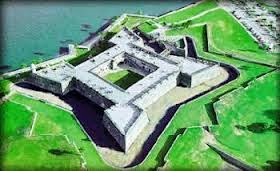
Then, in 1668 English privateer (and part time pirate) Robert Searle attacked St. Augustine. His aim was to loot the silver ingots held in the town’s royal coffers.  Under the cover of night, Searle and his men slipped into the harbor and attacked the sleeping town, killing 60 people and pillaging government buildings, churches and homes.  Because of the devastation wrought by these bloodthirsty pirates, Spain’s Council of the Indies finally issued money to build a massive stone fortress on Matanzas Bay to protect the city.

Spain was still thinking in terms of “castles” when they built stone forts. The so called “Castillo de San Marco” is made of a stone called coquina, (coe-keen-a.) Spanish for "small shells." The stone is composed of ancient shells that have bonded together to form a type of very soft stone similar to limestone.


Workers were brought in from Havana, Cuba, to construct the fort. The coquina was quarried from the King's Quarry, in what is today Anastasia State Park across Matanzas Bay from the Castle, and ferried across to the construction site. Construction began on October 2, 1672 and lasted twenty-three years, being completed in 1695.

One wonders what the workers thought of this native stone. Not much stronger than the shells it was composed of, the coquina stone seemed much too weak to withstand cannon fire. Yet the Castillo de San Marco is the only fort in the United States that has never been captured! How could this be? When bombarded by cannon fire, the soft stone walls absorbed the cannon balls, as if made of soft mud. Even today, the iron balls can be seen, embedded in the undamaged stone.


St. Augustine, with its strong fort, continued to grow, but remained a military outpost, rather than a plantation town. It was ceded to the English at the end of the Seven Years War in 1763, and was re-ceded to Spain at the end of the American Revolutionary War. It finally became part of the United States in 1819.

Today, St. Augustine is primarily a tourist town, cashing in on its rich history. Home of the oldest house in America, birthplace of the first European child recorded in the New World, the earliest free African settlement, and with an undefeated fort, the city has much to offer. It is also a haven for pirate lovers.


Every year, the pirate attack of 1668 is re-enacted in early March by local historical groups. The next event takes place on March 7th, 2015, which gives you plenty of time to plan your trip! Searles Bucaneers


Monday, May 5, 2014

La Buse - The Pirate with the Buried Treasure

Some pirates became what they were out of rage, some from an altruistic desire to elevate the lower levels of society, some even because they wanted to run away from home. This is the story of a French pirate who did it for fun, and left behind a mystery (and perhaps even a treasure) that lasts to this day.


Olivier Levasseur was born in the town of Calais, in northern France, sometime between 1688 and 1690. His family was wealthy, and he received an excellent education, then chose a career in the French navy. During the War of Spanish Succession (1701-1714) he procured his own ship and a letter of marquee from King Louis XIV, and became a privateer.

Capturing enemy ships and keeping a percentage of the value of ship and cargo was the job of a privateer, and it was a fine way to gain treasure. Levasseur had no real need of the money, but he seems to have become addicted to the excitement of hunting and catching ships.  When the war ended, all French privateers were ordered to return home, but Levasseur ignored the order, stayed in the Caribbean and became a pirate.

He soon earned the nickname of “La Buse” (The Buzzard) because of the speed and ruthlessness with which he attacked his enemies. His other nickname, “La Bouche” (The Mouth) is somewhat less flattering.
By 1716 he was traveling with English pirate Benjamin Hornigold’s pirate company. It was at this time that people began to note the scar over his right eye, which limited his sight.

The Frenchman sailed with Hornigold for approximately a year, befriending pirates Sam Bellamy and Edward Thatch, later known as Blackbeard. The long association is remarkable, for Hornigold refused to attack English ships, even when they were easy targets. Levasseur, who had fought against the English during the war, had no such scruples.

Played by Basil Rathbone in "Captain Blood."


Eventually the Hornigold party split, and Levasseur decided to try his luck on the West African coast. He teamed up with two more Englishmen in 1719, Howell Davis and Thomas Cocklyn. In 1720, the three attacked the slaver port of Ouidah, on the coast of Benin. Together they reduced the local fortress to ruins.

Later that year, he was shipwrecked in the Mozambique Channel and stranded on the island of Anjouan.
Legend says that Levasseur was instrumental in the building of a pirate fortification near Madagascar. 
Whether he built it or not, from 1720 onwards he launched his raids from a base on the island of Sainte-Marie, just off the Madagascar coast. Once again he had teamed up with English pirates, this time John Taylor and Edward England. His bad eye had been getting worse, and by now he was completely blind on that side, and began wearing an eye patch.


Pirates had dreamed for years of duplicating Henry Avery’s feat of capturing one of the Great Mughal's heavily armed and heavily laden pilgrim ships to Mecca. But opportunities like this do not come often. Levasseur and his friends first plundered a ship called the Locatives, and sold the loot to Dutch traders for £75,000 (about $17,077,500 in today’s money.)

Despite their success, the pirates had a falling out. It’s been suggested that Levasseur and Taylor got tired of England's kindness toward their captives. In any event, they marooned him on the island of Mauritius.

Edward England


At this point, Levasseur had no need of money. He could easily have retired on his last, enormous prize. But money had never been the point to his career. It was excitement the Frenchman was after. He found it, and everlasting fame, in his next exploit.

He and John Taylor were off the coast of Reunion island when they spotted an enormous ship, the Portuguese great galleon Nossa Senhora do Cabo (Our Lady of the Cape) also known as the Virgem Do Cabo (The Virgin of the Cape).  The vessel was loaded with treasures belonging to the Bishop of Goa and the Viceroy of Portugal, who were both on board returning home to Lisbon.

It seemed at first that the fight of a lifetime was brewing… the Portuguese ship showed a total of 74 gun ports, and Levasseur had only 26 cannons aboard his ship, while Taylor had even fewer. But the pirates had stumbled upon their prey at the most opportune time imaginable. The Cabo had been damaged in a storm, and to keep her from capsizing the crew had dumped all of her 72 cannon overboard, then anchored to undergo repairs. The pirates made their capture without firing a single broadside.

The booty consisted of bars of gold and silver, dozens of boxes full of golden Guineas, diamonds, pearls, silk, art and religious objects from the Se Cathedral in Goa, including the Flaming Cross of Goa made of pure gold, inlaid with diamonds, rubies and emeralds. It was so heavy, that it required 3 men to carry it over to Levasseur's ship. The total treasure was estimated at over 2 billion dollars in today’s money.

When the loot was divided, each pirate received at least £50,000 in golden Guineas (approximately $12,000,000), and 42 diamonds each. Levasseur and Taylor split the remaining gold, silver, and other objects, with Levasseur taking the golden cross.

For several years Levasseur concentrated on spending his treasure. Then, in 1724, he sent a negotiator to the governor on the island of Bourbon to discuss the amnesty that had been offered to all pirates in the Indian Ocean. However, the French government wanted a large part of the stolen loot back, so Levasseur decided to avoid the amnesty and settled down in secret on the Seychelles archipelago, just north of Madagascar.


Local custom permitted a man to have as many wives as he could afford, and several pirates set up tiny kingdoms for themselves. But the area was without the trappings of “modern” life. Food, clothing, and entertainment were very crude, and for a man from a civilized background, life must have occasionally been tedious. Levasseur continued to sail looking for more adventures.

Eventually he was captured near Fort Dauphin, Madagascar. The French authorities then took him to Saint-Denis, Réunion and hanged him for piracy at 5 p.m. on 7 July 1730.

Legend says that when he stood on the scaffold he had a necklace around his neck, containing a cryptogram of 17 lines, and threw this in the crowd while exclaiming: "Find my treasure, the one who may understand it!" What became of this necklace is unknown to this day.


The cryptogram, however, is said to endure. The codes and symbols in it have been linked to the Masonic Lodge, the Zodiac, the Clavicles of Solomon, and the Twelve Labors of Hercules. Arcane rituals, it is said, must be carried out in exact order for the treasure to be found.


A man named John Cruize-Wilkins, son of the man who re-discovered the cypher, has devoted his life to finding the treasure, and spend hundreds of thousands of his own money on earth-moving equipment, diving equipment, and permits. He knew that Levasseur was a scholar, and his description of how he believed the treasure was hidden is said to sound like a Dan Brown thriller.

And why would a pirate go to all that trouble to hide a treasure that no one was trying to steal?

"It's amazing what these guys did... the passion," Cruise-Wilkins marvels. And after all, what else did a semi-retired pirate have to do?