Monday, November 9, 2015

Pirate Festival – The St Augustine Pirate Gathering


I’ve been to a few pirate festivals, but being landlocked in the middle of North America, there’s only one recurring one locally. This past weekend, I packed my pistols onto a plane (checked baggage) and headed down to Florida for the 8th annual St Augustine Pirate Gathering.

Now, in the Midwest, pirate festivals are few and far between, but along the eastern seaboard there’s something happening nearly every weekend. This particular event came highly recommended, and besides, it’s in the oldest city in America, a place I wrote about here.


Air travel is certainly tiring, but it can go smoothly if you just keep your weapons out of the carry-on luggage. We met at Jacksonville airport, picked up our car (red VW Bug) and drove about 60 miles to St Augustine.

A few snags with the car meant the only event left on Friday night was the Buccaneer Bash, which was sold out. Our bad. The event featured all-you-can-drink rum, pirate rock and belly dancing. But my friend isn’t much of a drinker, and to tell the truth, neither am I. We hit the old fort instead.


The fort at St Augustine, Castillo de San Marcos, hasn’t changed much since 1695, but recent work has made it more visitor-friendly. We explored the site, talked to the park rangers and on-site reenactors, and exited through the gift shop, just like we were supposed to. A breeze was coming off the sea, and I enjoyed taking pictures during the ‘golden hour’, just before sunset.


We were up early to head to the festival the next day. Our hotel took one look at our costumes and comped us an excellent breakfast, but weather was not on our side. Not only was the temperature higher than expected, but humidity was 100%, and the Florida sun was merciless. I dressed in my coolest garb – a cotton skirt, gauze shirt, wide leather belt and accoutrements, including boots.


Kristi was cosplaying a pirate from one of my stories – a historical river-pirate named Sadie the Goat. Sadie got her nickname by head-butting her opponents in battle. She finally met her match and lost an ear to a huge Irish woman named Mag, who bit the ear off, pickled it, then gave it back to Sadie when they made up. Kristi was charmed by the story, and she wears a scarf over one of her own ears, and a human ear (plastic) on a string around her neck.

We avoided the sun by hitting the many merchants’ booths, checking out leather work, costume supplies, and jewelry. The rum bars were already in full swing (avoiding liquor laws by exchanging drinks for coupons bought at another establishment) but heat and humidity were killing us both. Kristy concocted her own pleasant drink from half-melted Italian ice and a shot of Code Rum, but I opted for water – and a cup of ice that went straight down the back of my neck. It felt wonderful.


After enjoying some of the acts at the main tent, we spent some more time people watching. Checking out the other pirates is always one of my favorite things to do, right after singing along with the musicians.


The pictures here are only a few of the crowd, which was an ever-changing, fast moving group in a wide variety of wonderful garb. Taking pictures was tough. Not shown here was a family pushing a baby carriage outfitted as a pirate ship. Inside was the family cat – clearly labeled as the captain! (What other position would a cat hold?)

We chatted with reenactors, vendors and musicians, opted out of the knife-throwing event (Kristi is already missing a finger) and finally gave up. It was just too damn hot!


Fortunately we had a plan. St Augustine is home to a world-class pirate museum, and it’s Air Conditioned! The clerk on duty was so taken with our garb (and Kristi’s ear) that we got in for half price, and enjoyed a tour by what turned out to be one of the Pirate Gathering’s organizers.


After the museum, we succumbed to the lure of a nearby bar-resteraunt. The outdoor location was cooled by fountains, trees and tropical plants. We sipped cool drinks, dined on conch fritters, talked about pirates with the locals, and listened to Bob Marley on the sound system. Jack Rackham and Anne Bonny would have approved.


Kristi wasn’t up for more partying that night, but I went back to chat more, drink more, and dance to the (excellent) bands. Many of the pirates were off on an organized pub crawl, but that just left more room on the improvised dance floor for the rest of us. One of the belly-dancers was doing the polka with an older pirate deep in his cups, and we even had a shot at a limbo. (Not a very successful shot, mind you!)

The night ended with more socializing (hint to handsome pirates – don’t tell me about your girlfriend if you’re trying to pick me up!) and then collapsing into bed.

It was a great little festival, and I’d go again. I hope to be one of the acts next year, since I passed out my card to the organizer. Maybe I’ll see you there.


Monday, November 2, 2015

New Pirate Music

The Golden Age of Piracy ended almost 300 years ago, and the days of fighting sail are long past. Sailors no longer load cannons by hand, and they certainly don’t need to “haul together” pump out the bilge or raise the sails. And yet pirate music lives on. In fact, it’s going stronger than ever.


Didn’t realize that new pirate music was being written? You’re probably in the majority. What surprises me is that the phenomenon isn’t just something that happened post-Pirates of the Caribbean. It kind of seems like people have written pirate music whenever they wanted to feel free. And now that piracy is no longer a hanging offense, singers can announce, “I’m a pirate!” even if that just means he wishes he was.


The first song I’m going to bring to your attention is the one that inspired me to write this piece. It was first recorded by Burl Ives, a folk singer who is best known in America as the voice of the snowman in the Rudolph the Red Nosed Reindeer Christmas special. Ives – gentle, round, and famous for playing a snowman, is the last person I’d associate with pirates. I haven’t been able to find a YouTube version of Ives playing the song, but it appears in his 1953 book, The Burl Ives Songbook.


This song seems to have been written by Lesley Nelson-Burns (sometimes Byrnes) who collected fold music. It’s a very unusual pirate song, and not only because it came out in the 1950’s when pirates were bad guys and non-conformist behavior was frowned upon.

The song is sung from the point of view of a pirate standing under the window of his lady-love, as he proposes marriage. It is soft, romantic, and yet definitely a pirate song. He promises her his heart, apologizes for not being as “smooth” at love as the landlubbes who surround her, and then offers gold, slaves, and a tropical island where it is always spring to be her home.


Woven into this narrative are lines which support my own view of pirates as social revolutionaries. The lovelorn pirate mentions cannon fire, battles at sea, and an exotic location where people are free. But he ends on a somewhat solemn note: He will keep his bride until “the black flag by inches is torn from the mast.” In other words, until the authorities defeat the pirates and haul down the Jolly Roger by force.

Hauling down the “colors” (national flag) was a universal sign of surrender during a sea-battle. In cases where a crew had decided to fight to the death, refusing to surrender, the flag might be nailed to the mast, so it could not be taken down, no matter what. A grim, but romantic, end to a romance.


My second song was written during a more pirate-friendly era, the mid-1970’s. The singer/songwriter Roger McGuinn, formerly of The Birds, named his album after the fictional pirate ship in the song, The Cardiff Rose. The title of the track is Jolly Roger.


It was the first modern pirate song I had heard, and I loved it instantly. The story is of a man on the run from the Royal Navy, fleeing to the Caribbean with heavy thoughts on his head. But his secret to happiness is to not linger on the past, but to concentrate on opportunities in the form of Spanish gold.

The song not quite historically accurate to the Golden Age, however. That might be asking a lot from a songwriter more concerned with rhythm, rhyme and theme than the finer points of sailing. In the song, the pirates attack “a clipper” a type of ship not invented until the 1850’s – about 150 years after Spanish gold was a major consideration.


Many things are right, however. The pirates win their prize, not in a gun battle, but by firing once across the merchant’s bow. I’m also quite fond of the line, “We took as much as we’d require: then we took the rest for our pleasure.” But my ultimate fave of the this tune is the conclusion –

“Now there's many a day on the Spanish Main
But none I hold so dear
As the happy day I first became
A scurvy buccaneer!”


Lastly, the song by the Rambling Sailors (one of my favorite groups) Pirate’s Life. This one had me on the first line. “It’s wonderful living the life of a pirate, with the freedom to take what you can.” What sums up the life better? The song was written by Gregg Caicos on his thirtieth birthday, which seems to me like a really great way to celebrate getting older.


I’ll leva you with this one… This world is for those who can grab it and old it. It’s true for everyone, and I wish you all a week of making the most of life. 


Monday, October 26, 2015

How Spanish Gold Made the Pirates


I’ve touched on the importance of the gold that Spanish conquistadores brought back from the new world – but today let’s look more directly at how this influx of money created the very circumstances that drive sailors to a life of outlaws.


I’ll center on England, since so many pirates were of English decent.

The discovery of the New World and the looting of its riches coincides very closely with the beginning of the English Renaissance. I don’t believe this is an accident.

During the Middle Ages, wealth was measured not in cash, but in land and in people. Land meant resources, and people was a rough count of how many soldiers a leader could bring to war. A leader who could bring a large army – even of semi-trained peasants, had more authority than someone who have fewer troops. And to bring the ultimate fighting force – trained archer, or trained knights, resources had to be great enough that people had time to practice skills.


Generations of young men of the “yeomanry” had spent their free time practicing the arts of war the way modern teenagers practice video games or skateboarding, with similarly impressive results.

But when Spain brought large amounts of gold into the European economy, things changed. Trade became ever more important, and the production of “cash crops” took on a sudden new importance.
Medieval villages were run much like families. The local ruler – perhaps a knight or baron, was at the head. Under him were the village family units – rather like the patriarch of a wealthy family rules over younger generations.


Under this system, no one was “unemployed.” Everyone had some work to do, and while some occupations brought better rewards than others, everyone who was a member of the group had a “living.” That is to say, some kind of a home, food comparable with their position, and small luxuries – new clothes, furniture, a well-made fireplace, that could be obtained by trading with the neighbors.

People worked, not for “wages” as we do today, but literally “for a living” – for food and shelter and clothing and society.

Image result for middle ages farmers


Even highly skilled individuals – portrait painters, for instance, didn’t make money for their work. Instead, they were taken in by “patrons” who gave them a living in exchange for their skills.

But, when Spanish gold came on the scene things changed. Money – and increasing trade – meant that, for the first time, the leaders of these sort of villages or holdings, could live VASTLY better than the people who actually did the work.

In the old system, the lord had a castle – but it was drafty, dark, and no cleaner that then huts of his villagers. He had the best of the local wool and weavers, and first dibs on the food and firewood. But the food he ate and the clothing he wore and the entertainment he had was only the best of the local production.


With money on the scene, land-holders could SELL the products of the workers, and buy luxury items. And, as a desire for these item drove trade, More luxury items were made and brought in through trade.

So, before, a good (locally produced) wool tunic was the mark of a lord. With money, the same man needed velvet or silk to show his position.


England’s great export was wool. Sheep had been raised and sheared since the beginning of civilization on the British Isles.  The climate made for superior wool quality, and weavers, creating cloth designed to keep out the cold and damp, produced a superior product.

Until this time, production was local. Farmers raised the sheep, gathered the wool, and a local weaver made the cloth. Now, wool could be sold.

What this meant was that the lord no longer needed people. He needed products. A more stable government meant that nobles were less likely to be called on to provide troops, and eventually keeping private troops even became illegal. The farmers who had sustained the noble class for years (in return for protection from bandits and other nobles) became a liability.


Landholders began to “enclose” common land and use it to graze sheep. Areas that had formerly provided grazing for cattle, forage for pigs and materials such as wild foods and herbal medicines were now used for sheep. The wool could be sold to dedicated weavers, people who worked using the highest technology looms. The lord had money to spend on luxuries. The farmers lost out.

Landowners also moved away from their holdings. The ancestral land became not a part of day-to-day life, but a source of money, of income.

Managers ran estates, and the goal became producing as much income as possible. Pressure was put on farmers – the largest segment of the population at the time – to produce more and more income.
In the late 1600’s the conditions became so alarming that private students of the structure of society – early, precursors to today’s social workers – described English farmers as “housed beggars.” The farmers could not raise enough to feed themselves and pay their rent. Raising their own sheep for wool was out of the question – old clothes were worn until they fell apart, and then the fibers were combed out, spun into thread and re-made. Some people were defined as “naked.” Malnutrition was serious.


Why did they stay? Because of the traditional roles of farmers and landholders. The landholders were supposed to “take care of” the folk who worked for them, to provide them with “a living.” But that relationship had broken down.

Eventually, many former-farmers left their land. There was only one real place to go. London was home to 1/10 of England’s population – over half a million people. By 1700, eight thousand people moved to the city every year. But the town did not grow. Instead, disease and overcrowding carried off more people than immigrated.


It was here that people learned for the first time about “wages” - money earned from work, which the worker then spent on the necessities of life, whether that amounted to a “living” or not.

Sam Bellamy and Charles Vane are believed to have come from this exact background, and I don’t believe that it is any accident that both of them were rebels and social revolutionaries.


Monday, October 19, 2015

Repairs at Sea

Pirates were in the taking business, not the fighting business. Time and again they proved that they'd rather create a terrifying persona and inspire a quick surrender than slug it out on the high seas. But fights did happen, and vessels became damaged in various ways. It might succumb to stress during a storm, run into a coral reef or some other debris, or simply suffer from rot that caused it to leak badly. What happened when the ship was going down?


First things first- was there a fire? Ships during the Golden Age of Piracy were made of wood, and waterproofed with pitch and tar, and so were about the most flammable things you could imagine. Fortunately fire-prevention measures were a standard part of shipboard life. Exactly where and when open flames could be used was highly regulated. Lanterns were used rather than open candles, pipe smoking was relegated to the open deck, and no fire at all was allowed too close to the gunpowder. The floor and walls of the galley - where a fire was required - were usually lined with tin.

Still, fires happened. During battle, each cannon was supplied with a bucket of water, and a ship going into battle usually had other various barrels and buckets full placed in strategic locations. Often sails would be wetted with sea-water before a fight. This not only reduced the chance of fire, but helped to reduce the porous nature of the canvas, making the sails "draw" better and increasing speed.


If fire broke out, getting the sails out of the way was an early priority. Hot air could dry the fabric fast, allowing it to burst into flame, and the downdraft from the sails might very well fan a fire. Flaming objects could be thrown overboard, and, obviously, all the available water would be thrown at the flames.

If there was time, the ship's pumps would be put into service. Normally, these pumps were used daily to empty any water that had leaked into the ship's lower levels. (All wooden ships leaked a little). The exit hose of the pump could be aimed at the fire. But often, before this could be done, the entire ship would be in flames. Fire was a serious business, and could destroy a ship in minutes.

If that happened, the only thing the crew could do was to get the ship's boats into the water and crowd into them.


If a cannon shot hit below the waterline, or if the ship hit a solid object and was damaged, immediate measures would also need to be taken. The ships were wooden, but they were loaded down with men, supplies, cannons and cargo, and they could sink. Repairing damage was the job of the carpenter, and his expertise could mean the all the difference in keeping the ship afloat.

If there was not an actual hole - if the ship's side was simply battered so much that it had lost integrity and was leaking water, the area of the damage might be shored up with braces, aimed at pushing the ship's timbers back into place. If this worked, then oakum - scraps of old rope that was too worn for use - was pounded into the loosened seams,  This sort of repair could be made in the middle of battle, adding to the sense of chaos.


Another action to keep the ship afloat was to position a canvas sling around the outside of the ship, covering the damage like a large bandage. This was a delicate operation, involving the careful placement of ropes and fabric, and often using improvised booms or cranes created from the masts and spars. It required knowing exactly where the damage was, which was not always possible on a crowded ship, and it could not be done during a battle. But it might very well slow the intake of water so the pumps could keep up while more permanent repairs were made.

If the ship took a hole "between wind and water" as the saying went, the main requirement was that debris should be kept out of the way of combatants during the fight. Afterwards, the carpenter might tap into supplies of wood on board, cannibalize other parts of the ship, or stop at a handy island in order to make repairs.


Damage to masts and sails could not sink the ship, but a falling mast could foul all the sails and kill men standing beneath. Furthermore, without sails and the masts to hold them, the ship was not moving, and might be sunk, captured, or driven onto a reef or shore. An immediate response was to cut away downed masts, and to hold damaged masts together with rope bindings, additional ropes to brace the mast and take away strain, and "fishing" the mast, which was basically the equivalent of putting splints on it, in much the way you might splint a broken limb on a person.


When masts were lost, additional pieces of wood - spars, smaller masts - might be hastily tied to the stump. This is one reason  why a sailing ship traditionally carried at least one replacement for every mast or spar. A huge main-mast could not be replaced in the heat of battle, but given the slightest opportunity, some sort of jury-rig could be set up, and some sort of canvas could be hung from it to supply power.

In the worst sort of extremity - if a ship had run aground, or taken damage to her hull that was letting in too much water to be controlled, desperate measures were called for. Getting rid of weight was one option, and the first thing to go was often the cannons, At perhaps half a ton apiece, the cannons were a substantial part of the ship's weight. Rolling them off the deck of the ship and into the sea would lighten it considerably, and could allow a badly damaged vessel to escape its pursuer, or stay afloat until repairs could be made.


Cannons lost this way of course, could not be brought back up again.

Cargo could also be thrown overboard, but due to its location and lighter weight, it was not so obvious a solution. Interestingly enough, when pirates came to port with cargo that could not otherwise be explained to the authorities, they often claimed to have picked it up from a ship that was damaged and need to "lighten its load."  This was the 18th century equivalent to "it fell off the back of a truck" and fooled no one, but it provided an excuse that could keep pirates out of jail.

If a ship wa not in immediate danger of sinking, her crew could do an amazing number of things to put her back into working order. The number of things that could be done with rope staggers the imagination.  Rope cold bind, support, lift, or brace, and it could be made into cushions to fill gaps i wood or rigging,  or pad parts that were rubbing together.


A skilled ship's carpenter could virtually re-build the ship from the hull up, given enough time and supplies. Ships carried spare fittings of every time, but also raw wood and unforged iron, which might become anything. And, whenever possible, a ship carried a miniature blacksmith's forge.

Pirates, of course, had one more option. If the pirate ship was too badly damaged in a fight, and the pirates had some means of getting to the enemy ship, they could simply take it. There are several exampled of sinking ships capturing an enemy vessel (their crews would be highly motivated, after all) and marooning that ship's crew. Hoisting the Jolly Roger over a new ship was one way to make sure that what you were standing on was seaworthy.


Monday, October 12, 2015

Pirate Quotes and Memes

Because I'm a pirate, I get all kinds of goodies in my "in" box. I enjoy them and let them go. But today, dear friends, I am going to share a selection with you.

Some provide food for thought

Either silly or serious


Sometimes even inspiring


Some solve age-old questions


And some are answers to questions you really don't want to answer


A few are about being stupid


And others are clever


Maybe even cutting edge


They take on points of grammar


The Food Pyramid


And international law


They are about good times


And bad


So let's remember the good times


Make it through the hard times


Stick together


And keep to the great pirate traditions


Because like the man said, being a pirate is the best life of all


Tuesday, October 6, 2015

Little Details for Your Pirate Costume


Okay, I have my own thing with pirate costumes - I'm stretching toward the most authentic I can construct. This involves a lot of research, recreation of old patterns, and hunting for authentic materials I can actually afford.

But YOU just want to be a pirate for Halloween, don't you? So, with that holiday coming up, here are some links to stuff that looks really cool, but that I'd never be able to use in my hyper-realistic pirate costumes.

As a girl, I'm going to start with this Treasure Chest Purse. Most costumes, especially girl's costumes, don't include anything even remotely like a pocket. So where do you put your cell phone and car keys, at the very least? Here's an answer. It has the look of a real pirate chest, is highly rated, and it seems like it's just the right size to hold what you need. (Like the other items on this list, I can't speak for it.... I've only looked at these items and thought "How cool!")

Next is an item that is so cool I'm actually trying to figure out a way to use it myself.  Two odd socks.. One with the traditional pirate stripe pattern, the  other with the wooden design of a peg leg! I love this! Lots of guys, especially, like to add some humor to a costume. This fill the bill without being stupid or gross.
Pirate Peg Leg Socks
This also happens to be the inspiration for this article. I just needed to share these things.

I also spent some time hunting down the best "Blackbeard's black beard" I could find (for a reasonable price). Here's where I also wanted to share a great Halloween idea for the ladies - put on a beard for the party. You'll be the talk of the event, and most guys don't even seem to mind. One of my favorite memories is of my tiny female friend in full Blackbeard regalia...


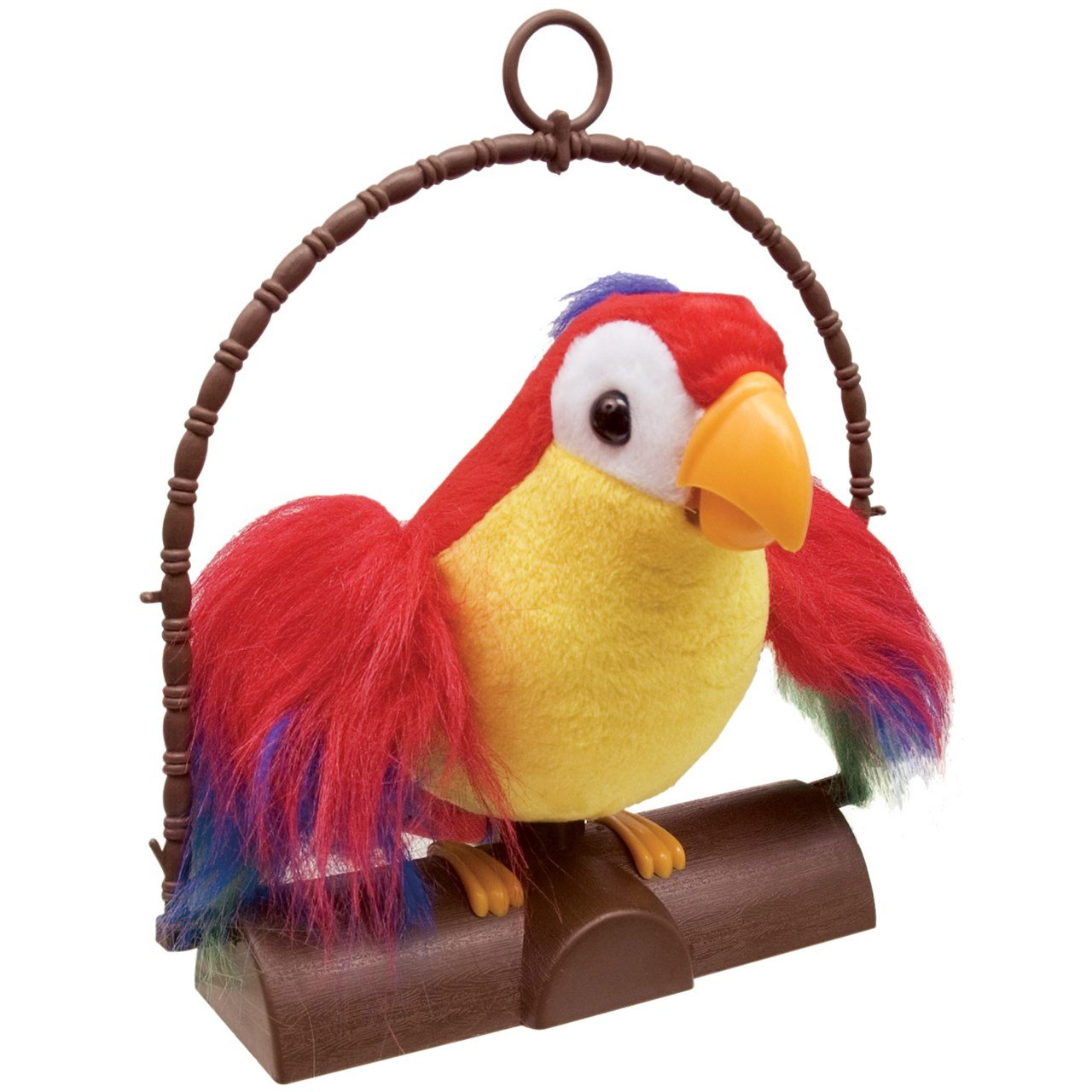
Next is a fun object for everyone. I've always wanted wanted one of these. They are available on Ebay on a regular basis, but they are expensive... About $250 dollars. But it's cheap compared to a real parrot, and the mechanical ones don't poop on your shoulder. Furthermore, you can turn this off or on with a remote control. (One of the reasons I will NEVER get a real parrot is the memory of a loooong afternoon at a friend's house. Her parrot would not stop singing "America the Beautiful".)


The item is called Squawkers Macaw, and it's part of the Fur Real Friends line of robotic pets. At a distance he could pass for a real parrot, though up close the clicking and whirring of his mechanical innards can be heard quite clearly.  I have a ren fair pirate with a Squawkers on his shoulder. He had stripped off the fake fur covering, and replaced it with hand-laid real feathers. It was an incredible look, but he didn't want me to take a picture.

There are cheaper mechanical parrots, of course. "Pete the Repeat Parrot" repeats whatever you say, but the quality just isn't there. Large costume stores also feature various forms of make-believe parrot, including some that are covered with real feathers. My favorite of these, however, is the inflatable version. If you're going to have a silly pirate mascot, you might as well go all the way.


My last offering is simply the suggestion that you get yourself a real sword rather than a plastic one for your pirate costume. It's true that real swords can run hundreds of dollars, but there are ways around that.

Why have a real sword? Well, pirates were supposed to be menacing, and there's no better way to feel the part than to have an authentic "hanger" by your side, ready for action. I was attending a patty once when the child of the house approached me and stated firmly, "That's not a real sword!" When I pulled out just a couple of inches of gleaming steel the child's eyes grew to the size of saucers and she backed off. (I also happen to believe that a little thrill of REAL fear is good for kids. It's the stuff of an authentic childhood. But I digress.)

The next question is why NOT to have a real sword. The answer here is that you can actually kill a person with one. You can get around this by zip-tying the sword in its sheath, or mostly in, so you can still show it off a little. Or take it easy on the rum, Your decision, mate, but I like to carry the real thing and just not act like a jerk.

So, where do you get a real sword without breaking the bank? One great place is your local sporting goods store, which probably carries machetes in the camping section for under $20. A modern machete looks a lot like an old-time sword, and the price is right.

Or you could go here  for a more pirate-y sword with a reasonable price tag. It's the cheapest place I know to get a reasonable-looking sword. If you are planning to make this pirating thing part of your life, you could do worse than to invest in a an actual blade to go pirating with.

I'd also like tell the story of how I got my won cutlass. I was in theater, and needed a sword for a production. This was theater at it's cheapest... I needed to buy the sword with my own money, or we would need to make a cardboard sword and cover it with aluminum foil.

I set out to my local flea market, looking for a King Arthur type sword. I couldn't  find one, but I did come across a classic pirate cutlass. It seemed to be the only sword in the market, and it was a good size for me and only cost $12.

I'm a believer in Fate, and in receiving messages. At the time, I wondered the universe sent me a pirate cutlass rather than what I had wanted. It was years later that I realized that , yo ho ho, this was the part of the pirate life that was just what I had needed.