Monday, October 19, 2015

Repairs at Sea

Pirates were in the taking business, not the fighting business. Time and again they proved that they'd rather create a terrifying persona and inspire a quick surrender than slug it out on the high seas. But fights did happen, and vessels became damaged in various ways. It might succumb to stress during a storm, run into a coral reef or some other debris, or simply suffer from rot that caused it to leak badly. What happened when the ship was going down?


First things first- was there a fire? Ships during the Golden Age of Piracy were made of wood, and waterproofed with pitch and tar, and so were about the most flammable things you could imagine. Fortunately fire-prevention measures were a standard part of shipboard life. Exactly where and when open flames could be used was highly regulated. Lanterns were used rather than open candles, pipe smoking was relegated to the open deck, and no fire at all was allowed too close to the gunpowder. The floor and walls of the galley - where a fire was required - were usually lined with tin.

Still, fires happened. During battle, each cannon was supplied with a bucket of water, and a ship going into battle usually had other various barrels and buckets full placed in strategic locations. Often sails would be wetted with sea-water before a fight. This not only reduced the chance of fire, but helped to reduce the porous nature of the canvas, making the sails "draw" better and increasing speed.


If fire broke out, getting the sails out of the way was an early priority. Hot air could dry the fabric fast, allowing it to burst into flame, and the downdraft from the sails might very well fan a fire. Flaming objects could be thrown overboard, and, obviously, all the available water would be thrown at the flames.

If there was time, the ship's pumps would be put into service. Normally, these pumps were used daily to empty any water that had leaked into the ship's lower levels. (All wooden ships leaked a little). The exit hose of the pump could be aimed at the fire. But often, before this could be done, the entire ship would be in flames. Fire was a serious business, and could destroy a ship in minutes.

If that happened, the only thing the crew could do was to get the ship's boats into the water and crowd into them.


If a cannon shot hit below the waterline, or if the ship hit a solid object and was damaged, immediate measures would also need to be taken. The ships were wooden, but they were loaded down with men, supplies, cannons and cargo, and they could sink. Repairing damage was the job of the carpenter, and his expertise could mean the all the difference in keeping the ship afloat.

If there was not an actual hole - if the ship's side was simply battered so much that it had lost integrity and was leaking water, the area of the damage might be shored up with braces, aimed at pushing the ship's timbers back into place. If this worked, then oakum - scraps of old rope that was too worn for use - was pounded into the loosened seams,  This sort of repair could be made in the middle of battle, adding to the sense of chaos.


Another action to keep the ship afloat was to position a canvas sling around the outside of the ship, covering the damage like a large bandage. This was a delicate operation, involving the careful placement of ropes and fabric, and often using improvised booms or cranes created from the masts and spars. It required knowing exactly where the damage was, which was not always possible on a crowded ship, and it could not be done during a battle. But it might very well slow the intake of water so the pumps could keep up while more permanent repairs were made.

If the ship took a hole "between wind and water" as the saying went, the main requirement was that debris should be kept out of the way of combatants during the fight. Afterwards, the carpenter might tap into supplies of wood on board, cannibalize other parts of the ship, or stop at a handy island in order to make repairs.


Damage to masts and sails could not sink the ship, but a falling mast could foul all the sails and kill men standing beneath. Furthermore, without sails and the masts to hold them, the ship was not moving, and might be sunk, captured, or driven onto a reef or shore. An immediate response was to cut away downed masts, and to hold damaged masts together with rope bindings, additional ropes to brace the mast and take away strain, and "fishing" the mast, which was basically the equivalent of putting splints on it, in much the way you might splint a broken limb on a person.


When masts were lost, additional pieces of wood - spars, smaller masts - might be hastily tied to the stump. This is one reason  why a sailing ship traditionally carried at least one replacement for every mast or spar. A huge main-mast could not be replaced in the heat of battle, but given the slightest opportunity, some sort of jury-rig could be set up, and some sort of canvas could be hung from it to supply power.

In the worst sort of extremity - if a ship had run aground, or taken damage to her hull that was letting in too much water to be controlled, desperate measures were called for. Getting rid of weight was one option, and the first thing to go was often the cannons, At perhaps half a ton apiece, the cannons were a substantial part of the ship's weight. Rolling them off the deck of the ship and into the sea would lighten it considerably, and could allow a badly damaged vessel to escape its pursuer, or stay afloat until repairs could be made.


Cannons lost this way of course, could not be brought back up again.

Cargo could also be thrown overboard, but due to its location and lighter weight, it was not so obvious a solution. Interestingly enough, when pirates came to port with cargo that could not otherwise be explained to the authorities, they often claimed to have picked it up from a ship that was damaged and need to "lighten its load."  This was the 18th century equivalent to "it fell off the back of a truck" and fooled no one, but it provided an excuse that could keep pirates out of jail.

If a ship wa not in immediate danger of sinking, her crew could do an amazing number of things to put her back into working order. The number of things that could be done with rope staggers the imagination.  Rope cold bind, support, lift, or brace, and it could be made into cushions to fill gaps i wood or rigging,  or pad parts that were rubbing together.


A skilled ship's carpenter could virtually re-build the ship from the hull up, given enough time and supplies. Ships carried spare fittings of every time, but also raw wood and unforged iron, which might become anything. And, whenever possible, a ship carried a miniature blacksmith's forge.

Pirates, of course, had one more option. If the pirate ship was too badly damaged in a fight, and the pirates had some means of getting to the enemy ship, they could simply take it. There are several exampled of sinking ships capturing an enemy vessel (their crews would be highly motivated, after all) and marooning that ship's crew. Hoisting the Jolly Roger over a new ship was one way to make sure that what you were standing on was seaworthy.



Monday, October 12, 2015

Pirate Quotes and Memes

Because I'm a pirate, I get all kinds of goodies in my "in" box. I enjoy them and let them go. But today, dear friends, I am going to share a selection with you.

Some provide food for thought

Either silly or serious


Sometimes even inspiring


Some solve age-old questions


And some are answers to questions you really don't want to answer


A few are about being stupid


And others are clever


Maybe even cutting edge


They take on points of grammar


The Food Pyramid


And international law


They are about good times


And bad


So let's remember the good times


Make it through the hard times


Stick together


And keep to the great pirate traditions


Because like the man said, being a pirate is the best life of all


Tuesday, October 6, 2015

Little Details for Your Pirate Costume


Okay, I have my own thing with pirate costumes - I'm stretching toward the most authentic I can construct. This involves a lot of research, recreation of old patterns, and hunting for authentic materials I can actually afford.

But YOU just want to be a pirate for Halloween, don't you? So, with that holiday coming up, here are some links to stuff that looks really cool, but that I'd never be able to use in my hyper-realistic pirate costumes.

As a girl, I'm going to start with this Treasure Chest Purse. Most costumes, especially girl's costumes, don't include anything even remotely like a pocket. So where do you put your cell phone and car keys, at the very least? Here's an answer. It has the look of a real pirate chest, is highly rated, and it seems like it's just the right size to hold what you need. (Like the other items on this list, I can't speak for it.... I've only looked at these items and thought "How cool!")

Next is an item that is so cool I'm actually trying to figure out a way to use it myself.  Two odd socks.. One with the traditional pirate stripe pattern, the  other with the wooden design of a peg leg! I love this! Lots of guys, especially, like to add some humor to a costume. This fill the bill without being stupid or gross.
Pirate Peg Leg Socks
This also happens to be the inspiration for this article. I just needed to share these things.

I also spent some time hunting down the best "Blackbeard's black beard" I could find (for a reasonable price). Here's where I also wanted to share a great Halloween idea for the ladies - put on a beard for the party. You'll be the talk of the event, and most guys don't even seem to mind. One of my favorite memories is of my tiny female friend in full Blackbeard regalia...


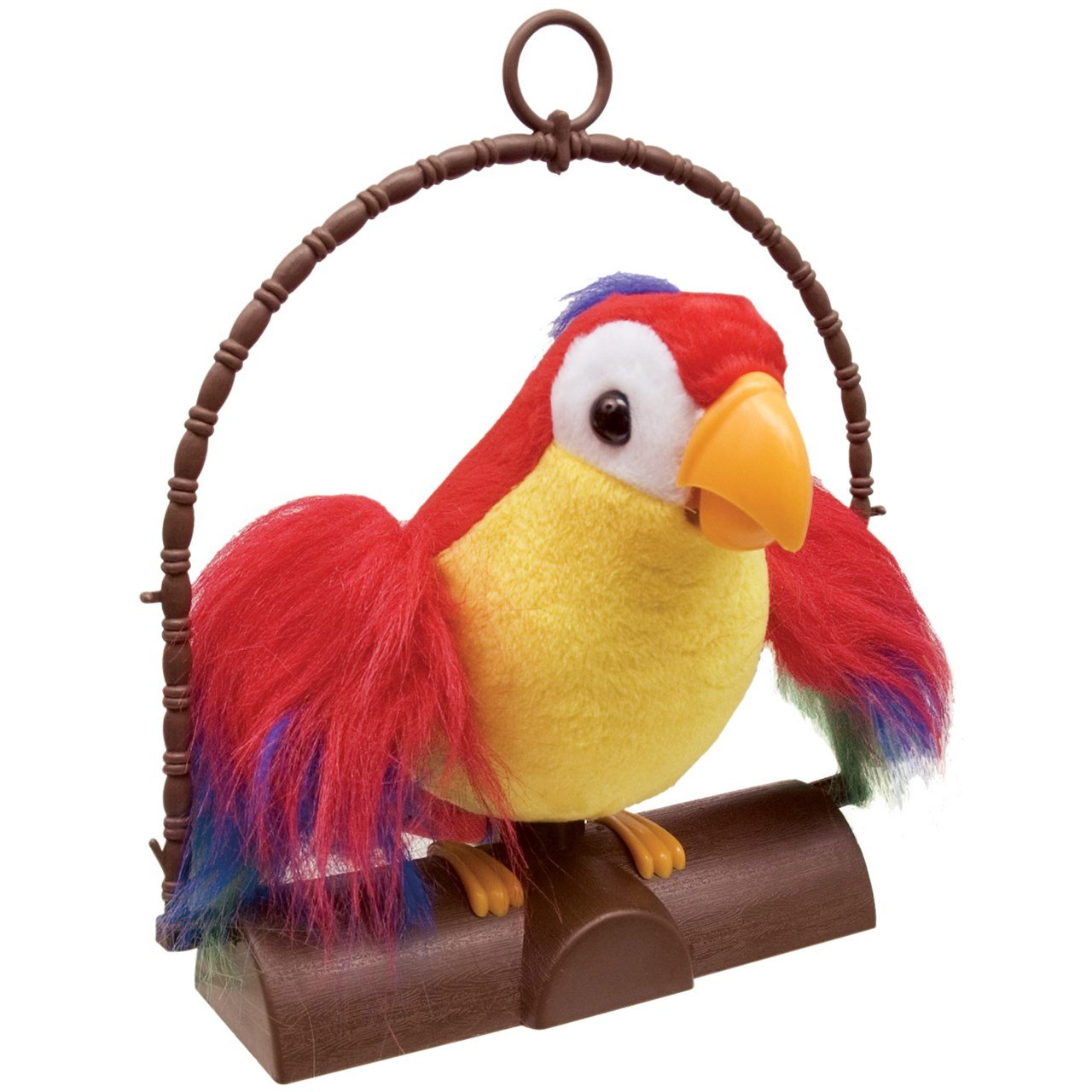
Next is a fun object for everyone. I've always wanted wanted one of these. They are available on Ebay on a regular basis, but they are expensive... About $250 dollars. But it's cheap compared to a real parrot, and the mechanical ones don't poop on your shoulder. Furthermore, you can turn this off or on with a remote control. (One of the reasons I will NEVER get a real parrot is the memory of a loooong afternoon at a friend's house. Her parrot would not stop singing "America the Beautiful".)


The item is called Squawkers Macaw, and it's part of the Fur Real Friends line of robotic pets. At a distance he could pass for a real parrot, though up close the clicking and whirring of his mechanical innards can be heard quite clearly.  I have a ren fair pirate with a Squawkers on his shoulder. He had stripped off the fake fur covering, and replaced it with hand-laid real feathers. It was an incredible look, but he didn't want me to take a picture.

There are cheaper mechanical parrots, of course. "Pete the Repeat Parrot" repeats whatever you say, but the quality just isn't there. Large costume stores also feature various forms of make-believe parrot, including some that are covered with real feathers. My favorite of these, however, is the inflatable version. If you're going to have a silly pirate mascot, you might as well go all the way.


My last offering is simply the suggestion that you get yourself a real sword rather than a plastic one for your pirate costume. It's true that real swords can run hundreds of dollars, but there are ways around that.

Why have a real sword? Well, pirates were supposed to be menacing, and there's no better way to feel the part than to have an authentic "hanger" by your side, ready for action. I was attending a patty once when the child of the house approached me and stated firmly, "That's not a real sword!" When I pulled out just a couple of inches of gleaming steel the child's eyes grew to the size of saucers and she backed off. (I also happen to believe that a little thrill of REAL fear is good for kids. It's the stuff of an authentic childhood. But I digress.)

The next question is why NOT to have a real sword. The answer here is that you can actually kill a person with one. You can get around this by zip-tying the sword in its sheath, or mostly in, so you can still show it off a little. Or take it easy on the rum, Your decision, mate, but I like to carry the real thing and just not act like a jerk.

So, where do you get a real sword without breaking the bank? One great place is your local sporting goods store, which probably carries machetes in the camping section for under $20. A modern machete looks a lot like an old-time sword, and the price is right.

Or you could go here  for a more pirate-y sword with a reasonable price tag. It's the cheapest place I know to get a reasonable-looking sword. If you are planning to make this pirating thing part of your life, you could do worse than to invest in a an actual blade to go pirating with.

I'd also like tell the story of how I got my won cutlass. I was in theater, and needed a sword for a production. This was theater at it's cheapest... I needed to buy the sword with my own money, or we would need to make a cardboard sword and cover it with aluminum foil.

I set out to my local flea market, looking for a King Arthur type sword. I couldn't  find one, but I did come across a classic pirate cutlass. It seemed to be the only sword in the market, and it was a good size for me and only cost $12.

I'm a believer in Fate, and in receiving messages. At the time, I wondered the universe sent me a pirate cutlass rather than what I had wanted. It was years later that I realized that , yo ho ho, this was the part of the pirate life that was just what I had needed.

Monday, September 28, 2015

Treasure Planet

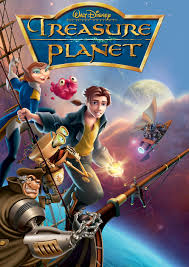
I didn’t originally want to see this Disney movie when it came out in 2002. Don’t get me wrong, I already liked pirates, and enjoyed the particular genre of steam-engine space tech called steam punk. But I firmly believed it was a flawed concept. Space movies should be space movies, and not hijack the immortal work of Robert Lewis Stevenson.


Nope Nope Nope Nope.

Man, was I wrong.

A friend dragged me to the movie, and I fell in love immediately. The basic tale – boy meets pirate, boy has father/son relationship with pirate, pirate reveals his true nature, boy overcomes pirate, pirate escapes with a pocket full of treasure, is known to practically everyone. But Disney cartoons have a well-known habit of “cleaning things up” I hadn’t wanted a sanitized version. I’d also felt that the “space” part of the space adventure would be just tacked on.


Instead, I found a lot “right”. The brown-and-gold color scheme of the movie works with the steam punk theme. The wide variety of aliens gives the piece an exotic feel, while letting Disney do anthropomorphic animals, something that Disney does well.

One of the things that advertising for the movie touted was the blending of computer-generated art with the more traditional hand-drawn style. This, too works amazingly well in the piece. The enormous sweep and movement of the ship (whose name has been changed from the Hispaniola to the R.L.S. Legacy – Robert Lewis Stevenson’s Legacy) is only enhanced by the abilities of CG. And the mechanics of Long John Silver’s cyborg arm (for in this, he’s not just a one-legged man, he’s a cyborg) is wonderful.


And the story, while it’s been changed a little (movie version tend to do this) is both true to the spirit of the original and relevant to modern audiences.


We open with Jim Hawkins as a child, reading a pirate story. This “pirate book” shows holograms of the action, so we get a quick mini-movie of Captain Flint zooming in to attack a merchant/passenger ship, before disappearing off into empty space. This sets up the mystery of the treasure right off, and shows off the terrifying visage of Flint.  As a pirate-historian, I also note that the proportions between the pirate vessel and the merchant are correct. Flint’s ship is much smaller.


Next the movie cuts to Jim as a fifteen-year-old, riding a cross between a skateboard and a para-sail. While he’s joyriding, his mom and Dr. Doppler (who replaces Dr. Livesey and is an obvious descendant of Goofy) chat about how Jim’s father ran out on the family, Jim’s mother is overwhelmed trying to run the Benbow Inn by herself. Clearly the family is reaching a crisis, exacerbated by Jim’s run-in with the law over his midair stunts.

Next comes a fast-paced sequence. Billy Bones crash-lands near the Inn and is rescued by Jim. The treasure map is discovered. Bones dies of his injuries. The pirates arrive hard on the heels of Bones. They tear the Inn apart, looking for the map, and end by setting it on fire. What takes six months in the book blows past in an hour, about 5 minutes screen time.


Now we’re in the heart of the story. Jim figures out how to open the projector for the map’s holographic images (great effect) and Dr. Doppler agrees to finance the mission to find the treasure. In no time, we’re at the spaceport, seeing the RLS Legacy and meeting Captain Amelia and her first mate, Mr. Arrow. Captain Amelia, a cat-like alien, is an Disney addition. Stevenson’s captain was male, of course, but a hyper-efficient female captain works very well, while giving the little girls a fine role-model. Amelia also provides inspiration for Doppler to find his inner hero, at which times she becomes a romantic figure.

The depiction of Long John Silver in the movie is, of course, what “makes” it. You can’t have any version of Treasure Island without a really good Silver. Brian Murray does the job as well as anyone ever has – His Silver is funny, smart, almost overwhelmingly full of personality, and, when the moment calls for it, terrifying.


Silver’s first job is to take Jim in hand. His actions – teaching the boy about how to pick his fights, demanding hard work from him in Jim’s work as cabin boy, telling tall tales and speaking to Jim about what makes a man a man, put him squarely in the “father figure” role. In the book this doesn’t come out nearly as strongly. And in many live-action versions Silver is responsible for the death of Mr. Arrow.

In this version, however, Silver is softened by giving this job to Scroop, the insectiod bad guy of the piece. Stevenson wrote a more realistic story by making the pirates their own worst enemies. They get drunk and disagree and fight among themselves. Disney doesn’t have time for that. He does the dirty work of killing Arrow, but Silver surprises and horrifies us by telling Scroop that the timing (not the murder itself) was wrong.


In this version, Silver starts his mutiny on the ship, beginning a frightening gunfight and gives the pirates a chance to hoist the Jolly Roger. At this point, when Jim escapes Silver’s clutches by stabbing him in his cybernetic leg, and the blaster-fire is thick, we truly see Silver as a pirate, greedy, self-serving and ready for violence.

On Treasure Planet, we meet the robot navigator B.E.N. (in place of the maroonee Ben Gunn) and Dr Doppler begins to lose realize that, while he may need to dither about the unimportant things, when life and death are on the line he’s a man of action. Captain Amelia is no less the hero, however.


In Treasure island, Stevenson shows us Silver standing up to the other pirates to save Jim. In this movie, he literally gives up his treasure for the boy, and in return, Jim uses his skateboard/sailing skills to save the entire party from an exploding planet. In this version the treasure (loot of a thousand worlds) is so vast that it MUST be disposed of, since anyone with so much wealth must necessarily be stuck with a whole slew of new problems.

At the end, Jim catches Silver sneaking away, and does not alert the others, even though he now knows what Silver is. And the pirate gives Jim just enough treasure (pulled from the copious pockets of the pirate coat) to re-build the destroyed Benbow Inn. Captain Amelia sends Jim to the Space Academy, she and Doppler marry, and the robot B.E.N. moves into the Inn to help Jim’s mom with the work. All is well, and Jim feels the presence of Silver watching him. We are safe, knowing that the pirate still roams free.


Disney built a very believable world/universe for Treasure Planet, with a steam punk design of 70 percent “old” (antique clothing, beamed ceilings, furniture, tools) and 30 percent “new”(solar sails, ray guns, cybernetics)  They tried out the esthetics for Long John Silver’s prosthetic arm and leg by first attaching it to another hand-drawn pirate – Hook.  

They also left in a lot of the scary bits. Arrow’s death – falling into a Black Hole – is more graphic than his ending in the book, when he simply disappears between night and morning, presumably pushed into the sea by Silver. Disney also kept In a terrifying one-on-one fight to the death between Jim and Scroop (standing in for the pirate Israel Hands). Disney couldn’t keep all f the fight, of course. In the book, Jim has a flintlock pistol, and threatens to shoot his pursuer in the face. In Treasure Planet, Scroop’s’ fate – flying off into space when the gravity fails – mimics the death he gave to Mr. Arrow.


Things I especially like about the show?
Jim’s tortured, bad-boy character, barely masking a lonely child.
The entire relationship between Jim and Silver. The older man is hard n Jim, and we see what Jim needed that his mother couldn’t give him.  But we also see genuine affection. Silver even hints at some of his own back-story, admitting that he gave up a lot to search for Flint’s treasure as he rubs at his mechanical leg.
The depictions of Flint are also excellent. The character of Flint has no first name in Stevenson’s book, and the choice her o of “Nathaniel” works for me. The pirate captain’s six-eyed face is terrifying, and lets us identify his skull at a crucial moment.


Things I hate?
Just the robot B.E.N., whom I think Is just there to be cute. I hate cute.

All it all, it’s really one of Disney’s better efforts. But the movie didn’t do well in theaters. A lot of people probably shared my confusion about Treasure Island in space. But Netflix has given it a second life, and it has also taken on a cult status with the Steampunk crowd.

Disney had originally planned a sequel, in which Jim, while in the Space Academy, gets involved with the theft (by pirates) of a  prototype super-ship designed by Dr. Doppler and armed with a mega-weapon. Silver gets called in from his smuggling business to help out, and Jim finds romance with the Admiral’s daughter.


It would have been a grand romp. And now… Who can tell? The popularity of Treasure Planet is growing, not shrinking. We may see that sequel yet.


Monday, September 21, 2015

Crossing the Equator


Crossing the equator has long been an act filled with ritual significance. Recently, the degree of hazing used in the US Navy has come under scrutiny for being physically and psychologically damaging to the participants. Defense for the custom states that these rituals go back hundreds of years.

They do, in fact. Some were in place during our time period, the early 1700’s. We’re going to take a look at some of these early rituals, and perhaps touch on how they developed over the years.


It’s a popular misconception that, before Columbus “discovered” the New World, Europeans believed that the world was flat. This is not true at all. The ancient Greeks had done the math to prove the world was round, and were within a few miles of being accurate in its size.

Furthermore, sailors, who regularly watched land drop away behind them, and who estimated the range of distant ships by seeing how much of the vessel was below or above the horizon, knew perfectly well that they weren’t going to fall off the edge of the world.

The equator, however, was s different matter.

What is the equator, anyway? The modern definition is that it is an imaginary line surrounding the middle of the earth, at an equal distance from the North Pole and the South Pole. It divides the world into the Northern and Southern Hemispheres.

This does not seem significant in today’s world, but it matters more than you might think. And the sailors of days gone by, it was of absolutely grave importance. You see, as s ship moves around the globe, the bulk of the earth blocks out certain constellations. And at the line of the equator, the most important object in the northern sky disappears.

The North Star – Polaris.


The Northern Hemisphere is lucky to have what appears to be a “fixed” star in its sky. Polaris sits almost directly over the North Pole. As long as the star can be seen, the direction “north” can be determined. For a ship out-of-sight of land, this information is crucial.

But to a person approaching the equator, Polaris appears to be lower and lower in the sky. At the equator, the star sits exactly on the horizon. Past the equator, it disappears. The marking used to designate latitude indicate the apparent height of Polaris in the sky. And at the equator, the number is ominous – Zero.

So what’s on the other side of zero?

South America. Sub-Saharan Africa, and Australia. Unknown lands. Also, an unfamiliar navigation system, using not a fixed star, but the constellation of the Southern Cross. Instead of a fixed star, the Southern Hemisphere depends on locating the center of a group of four stars to determine north. Trickier going.

So, approaching this mystical place seemed to require some sort of ceremony.

 
The French are credited with the earliest “Crossing the Line” ceremonies. Experienced sailors liked to tell younger ones that traveling below the equator was what caused a person’s skin to become black. On the day of the fateful crossing, crew members covered themselves with substances such as the soot from lamps and burned cork. When they were suitably blackened, they burst out upon the recruits, “captured” them, terrified them, and then blackened their faces in a similar way.

Having gone through the ceremony, these young men were now in on the joke, and would become the next generation to perpetrate the hoax.

But it was the English who created the most elaborate “Crossing the Line” ceremonies. Over time, the English developed a tradition of spending and entire day under the rule of “King Neptune” or “Neptunus Rex”. A crew member would dress up in an elaborate costume as the King of the Sea. He would be surrounded by a “royal court” and would hold control over the ship for a period of time. Very often pirates were part of the King entourage. I think this may have been a symbol of chaos. 


 Men who had not crossed the equator before were judged, punished, re-baptized, and given over to King Neptune. After the ceremony, they were considered to have fundamentally changed. In a time when the Christian God was seen to have constant, active agency in every action and outcome on earth, tearing oneself away from Him, and being given to Neptune, must have been a profound experience.

As time went by, the ritual grew. The recruits were called Pollywogs, or Wogs; the experience men were Shellbacks. According to ritual, the Wogs were slimy, unreliable, effeminate creatures, unworthy to be called true sailors. (It should be noted that this was part of the ritual. Before approaching the equator, sailors who had not experienced the crossing were treated as shipmates in the usual way.)  Shellbacks were true men, honest, masculine, reliable and trustworthy.


 The hazing part of the ceremony took on more and more epic proportions. Initiates had always received some sort of beating as part of the ceremony – in the 1700’s sailors were beaten on a regular basis, so a few blows were not regarded as a big deal. The beating part of the ritual probably just confirmed what these men already knew, that they had chosen a rough profession. In the 18th century having whip scars was part of the proof that one was a sailor.

But  in more recent times , being beaten with was a more serious deviation from the norm.

In the early days, it was a common part of the ceremony to douse recruits in animal blood. On ships that kept live animals as a food source this was easy to come by, and it symbolized the blood of rebirth. The later washing of the recruits, in turn, symbolized baptism, as the recruit was symbolically given to the sea.

Later ceremonies, not having access to fresh blood, substituted garbage. And when the garbage was not enough, sewage was added. Recruits were stripped, covered with lard (and later Crisco), and doused in human waste. Elaborate cross-dressing rituals were added to the fun. It’s possible that they had been there for a long time. Ritual cross-dressing has been part of pre-Christian ceremonies back to the dawn of time, and part of the point of the crossing ceremony seems to have been ‘paganizing’ the recruit. But modern ceremonies included “beauty pageants” and mock strip-shows.  Even mock sex acts were common.


Modern sailors rebelled, and went to court, demanding changes, and the excess of the Crossing ceremony have been toned down considerably. Did the ceremonies begin to go too far? Probably. But the rituals still exist. King Neptune still owns the souls of those who go to sea.